

The 1st Regional Convening on Child Domestic Work in East Africa: Building a Regional Movement for Protection, Justice and Dignity

A Historic Gathering to Address One of East Africa's Most Hidden Forms of Child Exploitation
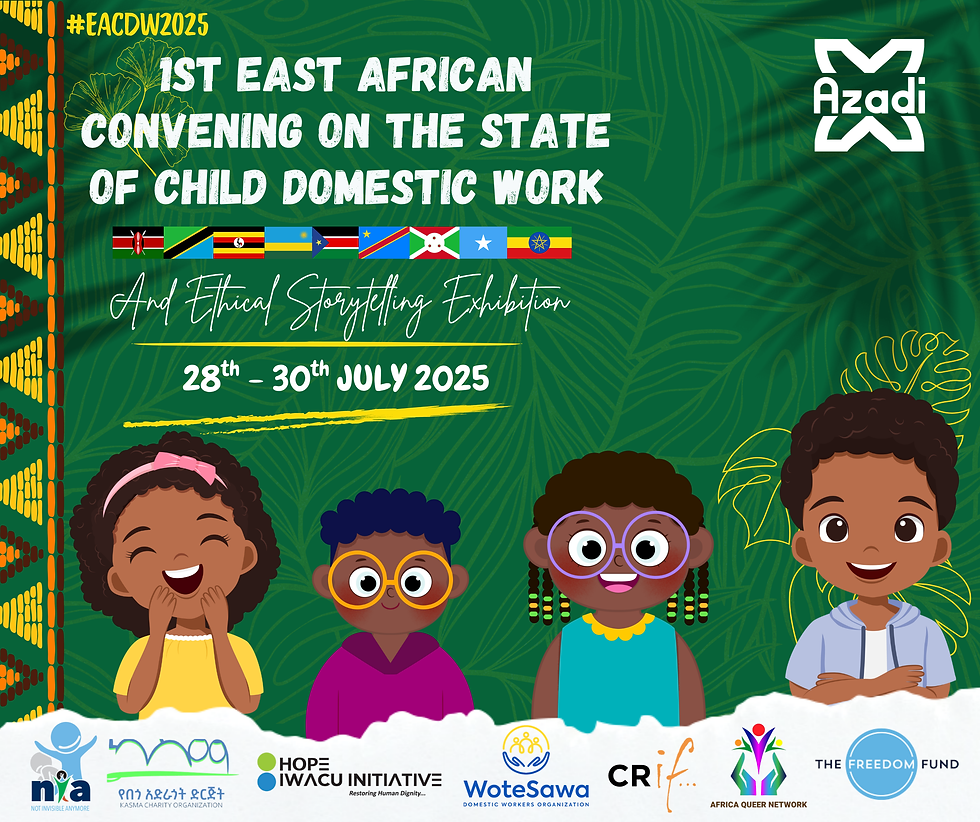
On 28th -30th July 2025, Azadi Community hosted the 1st Regional Convening on the State of Child Domestic Work (CDW) in East Africa in Nairobi, Kenya. The convening brought together over 100 participants from Kenya, Uganda, Tanzania, Rwanda and Ethiopia, including people with lived experience, government representatives, civil society organizations, child protection actors, researchers, practitioners, media partners and survivor leaders.
The convening was more than a conference. It was a regional call to action. It was a space where evidence met lived experience, where policy met practice, and where those most affected by child domestic work were placed at the centre of conversations about solutions. The gathering culminated in the development of a Regional Policy Brief on Addressing Child Domestic Work in East Africa, providing concrete recommendations for governments, development partners, and civil society actors across the region.

Why Child Domestic Work Matters
Child Domestic Work remains one of the most hidden and underreported forms of child labour in East Africa. Unlike other forms of labour that occur in public spaces, domestic work often takes place behind closed doors, making it difficult to detect, regulate and address. Many children, particularly girls, experience exploitation, abuse, denial of education, trafficking and violations of their fundamental rights while working in private households.The policy brief developed from the convening highlights that an estimated 250,000 to 300,000 children in Kenya are engaged in exploitative domestic work, while similar
patterns exist across Tanzania, Uganda, Rwanda and Ethiopia.
Yet despite its prevalence, child domestic work remains largely invisible.
The convening sought to change that.
Bringing Together Diverse Voices
Participants travelled from across East Africa to share experiences, evidence and promising practices. The convening created a rare regional platform where survivor leaders, policymakers, community organizations, legal experts, child protection practitioners and grassroots activists could collectively examine the realities of child domestic work and identify pathways for change.
Throughout the three days, conversations explored:
The current state of child domestic work across East Africa.
Legal and policy frameworks in different countries.
Survivor support and long-term reintegration.
The role of feminism and movement building in addressing child domestic work.
Cultural norms that perpetuate child exploitation.
Community-based solutions and prevention strategies.
Mental health and psychosocial support for survivors.
Sustainable and survivor-centred approaches to combating exploitation.
Learning from East Africa's Realities

One of the most powerful aspects of the convening was the comparative analysis of child domestic work across the region.
Participants explored how poverty, displacement, gender inequality, harmful cultural norms, family separation, lack of educational opportunities and weak social protection systems continue to drive children into exploitative domestic work. Through collaborative exercises, participants mapped the root causes, consequences and potential solutions to child domestic work, highlighting the need for stronger governance, social protection, access to education, psychosocial support and community awareness.
Discussions also revealed common challenges across the region:
Weak enforcement of child protection laws.
Lack of reliable data.
The hidden nature of domestic work within private homes.
Limited rehabilitation and reintegration services.
Gaps between education policies and minimum working age laws.
Inadequate referral and reporting systems.
Survivor Leadership at the Centre
A defining feature of the convening was its commitment to survivor-centred practice.
Conversations on survivor support and long-term reintegration challenged traditional understandings of recovery. Participants described reintegration as a complex and non-linear journey requiring safety, dignity, community support and opportunities for leadership. Rather than viewing survivors solely through the lens of victimhood, the convening highlighted the importance of agency, co-creation and survivor leadership in shaping solutions.
The message was clear: meaningful responses to child domestic work must include those who have lived through exploitation.
Child Domestic Work as a Cultural and Social Issue
The second day focused on understanding child domestic work as a harmful social and cultural practice.
Through discussions led by child-focused media practitioners, participants explored how media can challenge harmful narratives, empower children and create opportunities for children to influence public discourse. The sessions highlighted the importance of creating child-friendly spaces where children can express their views, shape conversations and participate in decisions affecting their lives.
This reinforced a critical lesson from the convening: children must not only be protected but also meaningfully engaged in shaping the policies and systems intended to protect them.
Community Learning Beyond the Conference Room
To deepen learning, participants visited organizations actively working to combat exploitation and strengthen child protection systems.
These visits included:
Childline Kenya, where participants witnessed firsthand how the 24-hour child protection helpline operates and learned about reporting, referral, and case management systems supporting vulnerable children.
The Centre for Domestic Training and Development (CDTD), where participants explored survivor-centred shelter and reintegration approaches for girls affected by child domestic work, trafficking, and gender-based violence.
Nivishe Foundation, where discussions focused on mental health, trauma-informed care, and the critical connection between mental wellbeing and prevention of exploitation.
Azadi Community, where participants engaged in discussions on survivor-led programming, sustainable funding, and the launch of Kipato Unbranded, a social enterprise supporting women survivors through ethical employment pathways.
These visits transformed theory into practice and allowed participants to see innovative models already making a difference within communities.
A Key Outcome: The Regional Policy Brief
One of the most significant outcomes of the convening was the development of the Policy Brief on Addressing Child Domestic Work in East Africa.
Drawing from evidence, lived experiences, regional discussions and country-specific realities, the brief provides recommendations for governments and stakeholders across East Africa. These include:
Harmonising legal and policy frameworks across the region.
Strengthening cross-border coordination and anti-trafficking systems.
Improving child protection and referral mechanisms.
Investing in data collection and research.
Expanding access to quality education and social protection.
Strengthening rehabilitation and reintegration services for survivors.
The policy brief represents a collective regional voice calling for stronger action to protect children from exploitation.
Building a Regional Movement
Perhaps the most important achievement of the convening was the sense of collective purpose it created.
The event laid the foundation for a growing regional movement committed to ending child domestic work through collaboration, survivor leadership, evidence-based advocacy and policy reform. Participants left not only with new knowledge and partnerships but with a shared responsibility to ensure that children across East Africa are protected, heard and given the opportunity to thrive.
To continue the conversation and support advocacy efforts across the region, we invite you to explore the resources developed through this historic convening:
Download the 1st Regional Convening on Child Domestic Work Report
Download the Policy Brief on Addressing Child Domestic Work in East Africa
Watch the Convening Highlight Videos
Together, we can make child domestic work visible, strengthen protection systems, and build a future where every child can learn, play, dream, and thrive free from exploitation.
References:
https://respect.international/wp-content/uploads/2023/05/GFEMS_DomesticWorkers_Uganda.pdf
2022 Findings on the Worst Forms of Child Labor: Rwanda
https://ijls.jurnal.unej.ac.id/index.php/ijls/article/view/34844?utm_source=chatgpt.com
https://dailynews.co.tz/tanzania-makes-strides-in-curbing-child-labour
Kenya: https://www.dol.gov/sites/dolgov/files/ILAB/child_labor_reports/tda2024/Kenya.pdf
Ethiopia: https://www.dol.gov/sites/dolgov/files/ILAB/child_labor_reports/tda2024/Ethiopia.pdf
Uganda: https://www.dol.gov/sites/dolgov/files/ILAB/child_labor_reports/tda2024/Uganda.pdf
Rwanda: https://www.dol.gov/sites/dolgov/files/ILAB/child_labor_reports/tda2024/Rwanda.pdf
Tanzania: https://www.dol.gov/sites/dolgov/files/ILAB/child_labor_reports/tda2024/Tanzania.pdf


Comments